Fair comparison
Nesty vs Bark for child Android tablets.
Bark is a broad parental-control and monitoring product. Nesty fits a narrower job: making one Android child tablet show clearer routines, app lanes, KidTube, chores, rewards, schedules, quiet hours, and visible rules.
Short answer
Pick Bark for monitoring and alerts. Pick Nesty for child-visible tablet routines.
Both products are relevant to Android families, but they answer different parent questions. Bark is closer to a monitoring, alerting, screen-time, filtering, and location product. Nesty is closer to a controlled Android tablet routine that the child can see and the parent can verify.
Bark is broader
Bark documents monitoring for texts, photos, videos, web browsing, email, and many Android apps, plus screen time, web filtering, location, and alerts.
Nesty is tablet-routine first
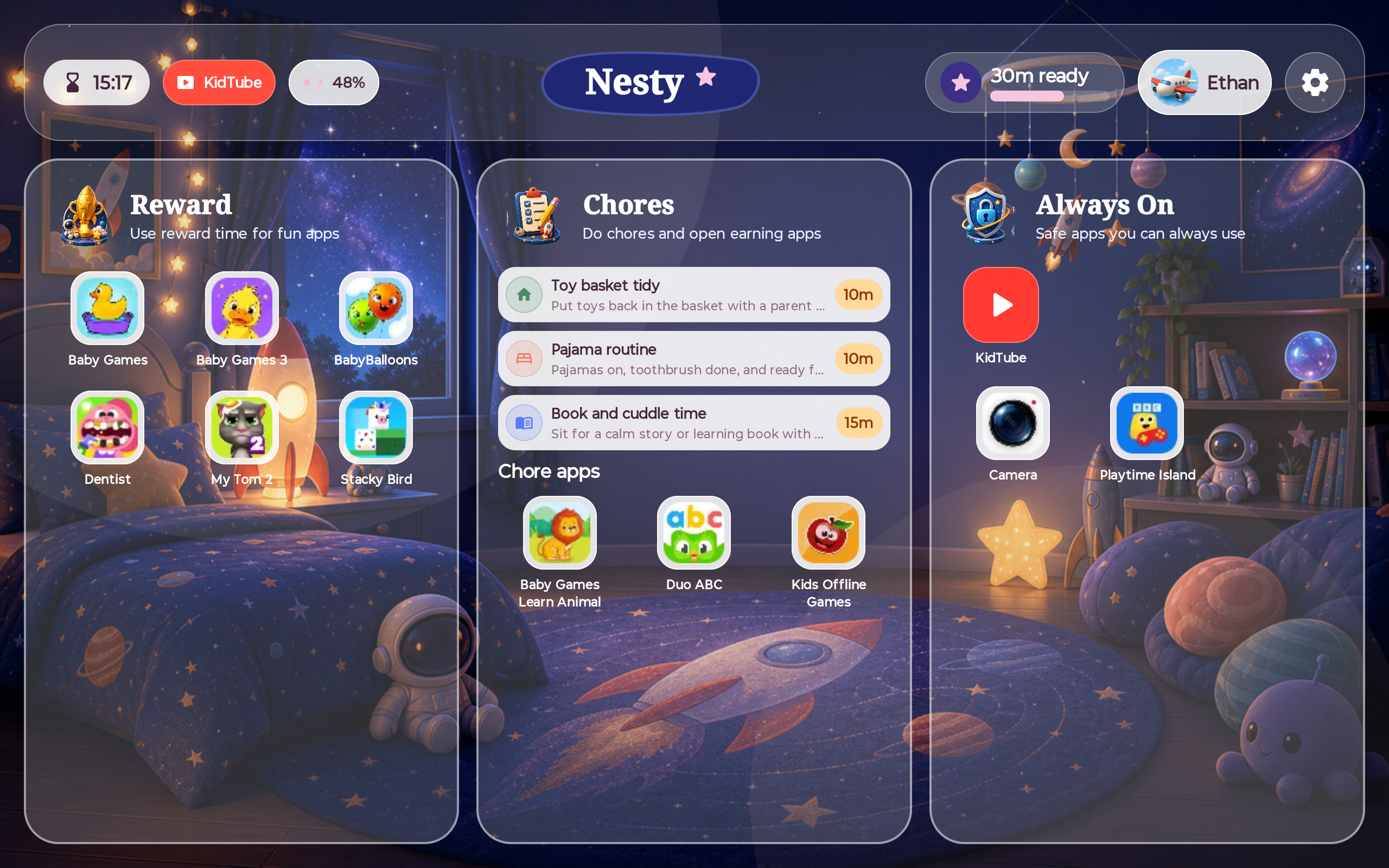
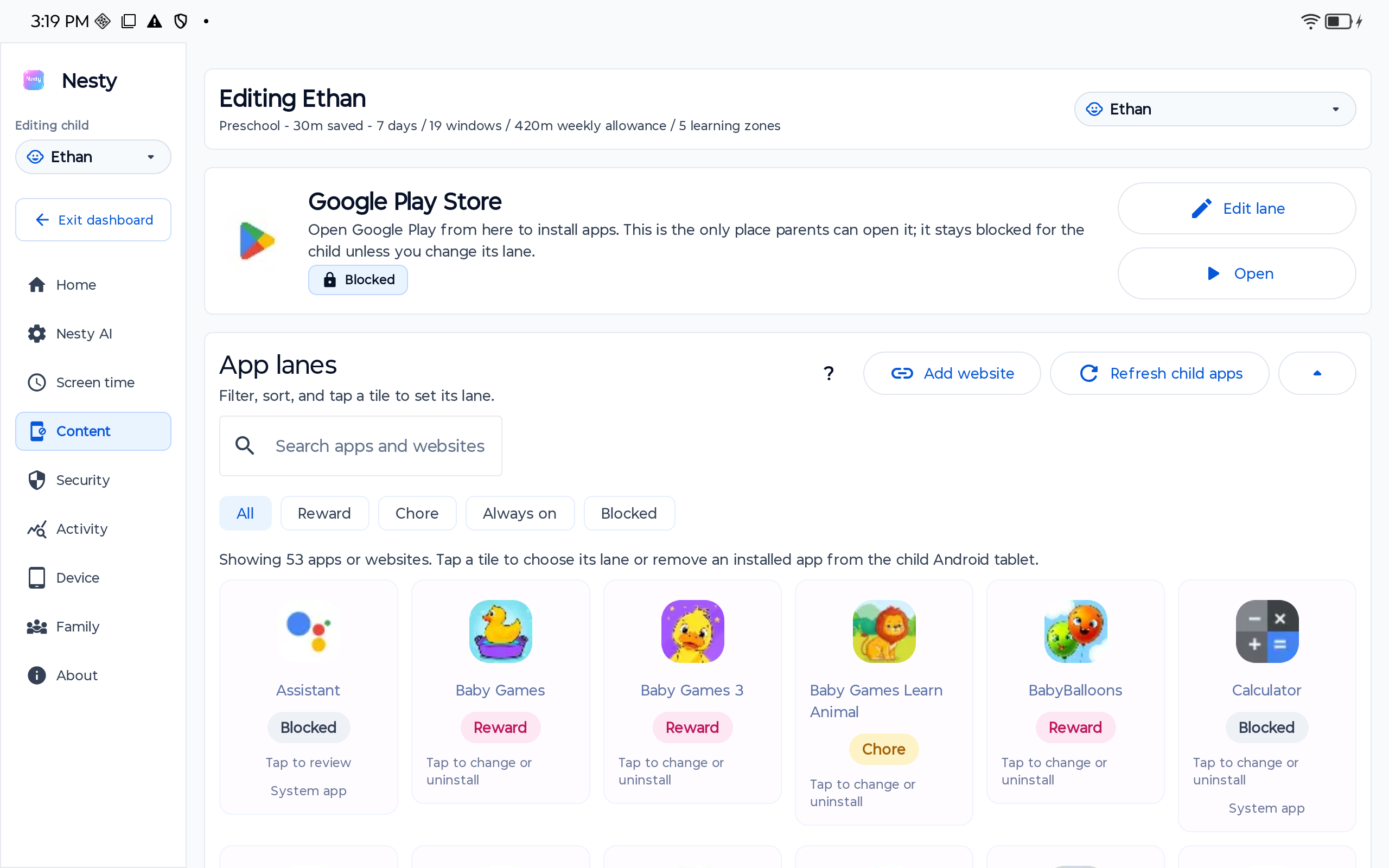
Nesty focuses on app lanes, KidTube, chores, rewards, schedules, quiet hours, and the child tablet's visible rule state.
Setup model matters
Bark's Android setup can involve the Bark Kids app and device permissions. Nesty setup should be tested against the exact Android child tablet and parent dashboard.
No blanket winner
Choose by the job: safety alerts and oversight, or child-facing Android tablet routines.
Where Bark is strong
Bark is built for monitoring, alerts, filtering, and location.
Bark's official pages describe advanced content monitoring, scanning across text messages, social apps, browsers, email, images, videos, and online activity, with alerts for concerning issues. Bark also documents screen-time schedules, web filtering, app and site blocking, SafeSearch locking, location features, and Bark Home controls for home Wi-Fi devices.
That makes Bark relevant when a parent wants broader digital-safety oversight, not only a clearer child-tablet routine.
Where Nesty fits
Nesty is built around the tablet day the child actually sees.
Many families do not only need more monitoring. They need the tablet to make the rule obvious: learning first, reward apps later, KidTube only when allowed, always-on tools still available, and quiet hours that do not require a fresh argument.
Side-by-side
Compare the parent job, not just the feature list.
Bark and Nesty overlap on screen time, web limits, and app access, but their center of gravity is different.
| Parent need | Bark | Nesty |
|---|---|---|
| Monitoring and alerts | Stronger fit. Bark documents monitoring for texts, photos, videos, web browsing, email, social apps, and safety-alert categories. | More focused. Nesty is not a text-message, social-media, location, or broad content-monitoring suite. |
| Screen time | Supports app/site schedules, internet access windows, and screen-time rules across mobile devices and Bark Home setups. | Uses schedules, quiet hours, app lanes, earned reward windows, and child-visible lock messaging. |
| App and web access | Supports category rules, specific site/app blocking, SafeSearch locking, and Bark Phone app controls where applicable. | Separates apps by family purpose: always-on tools, chores or learning, rewards, blocked apps, and KidTube. |
| Video habits | Useful when parents want monitoring and filtering around online activity and browser/app access. | Focuses on using KidTube for an approved-channel video path on the child tablet. |
| Child-tablet clarity | Useful for parent oversight, alerts, and broader device/account signals. | Stronger fit when the child needs to understand the tablet rule directly from the screen. |
| Setup diagnosis | Check Bark Kids app state, monitoring setup, permissions, filtering mode, schedules, device type, Bark Home/router state, and plan/product fit. | Check selected child, tablet pairing, app lane, KidTube visibility, schedule window, reward state, and parent-dashboard/tablet sync. |
Decision checklist
Bark may be enough when alerts and oversight are the main need.
Start with Bark if your priority is content monitoring, alerts, web filtering, app/site schedules, SafeSearch locking, location, or a broader family-device safety product.
Choose Nesty when the parent problem is the daily Android tablet routine: which apps are learning, which apps are rewards, whether KidTube is visible, what happens at bedtime, and whether the child screen matches the parent rule.
Data integrity check
When a tablet rule fails, inspect setup state before blaming the product.
For Bark, check the correct child profile, Bark Kids app state, monitoring setup, permissions, screen-time schedule, web/app filtering rule, Bark Home or router state where relevant, device type, and whether another control layer is active.
For Nesty, check the right family, child profile, physical tablet, Android version, app lane, schedule, KidTube visibility, reward state, and whether the child tablet has the latest parent-dashboard payload.
Limits
Neither product removes the need for supervision.
Monitoring, app blocking, website limits, screen-time rules, approved video paths, reports, and alerts can reduce risk and make family rules easier to keep, but parents still need age-appropriate choices, device testing, updates, and conversations.
Nesty is focused on Android child tablets. It should not be described as a universal monitoring suite, a Fire tablet replacement, an iPad protected-mode product, or a guarantee that every Android manufacturer behaves the same way.
FAQ
Bark and Nesty questions.
Short answers for parents comparing Bark with Nesty for child Android tablets.
Is Nesty a Bark alternative?
It can be, when the parent wants child-visible Android tablet routines rather than broad monitoring. Bark is broader for alerts, monitoring, location, screen-time controls, and web filtering.
What is Bark best at?
Bark is strongest when parents want monitoring, safety alerts, web filtering, screen-time schedules, location features, and broader digital-safety oversight.
What is Nesty best at?
Nesty is best suited to parent-managed Android child tablets where visible app lanes, reward rules, KidTube, schedules, and setup agreement matter.
Can Nesty and Bark be used together?
Possibly, but test on the exact tablet. Multiple parental-control tools can compete for permissions, app blocking, web filtering, accessibility services, VPN or network behavior, notifications, and battery behavior.